
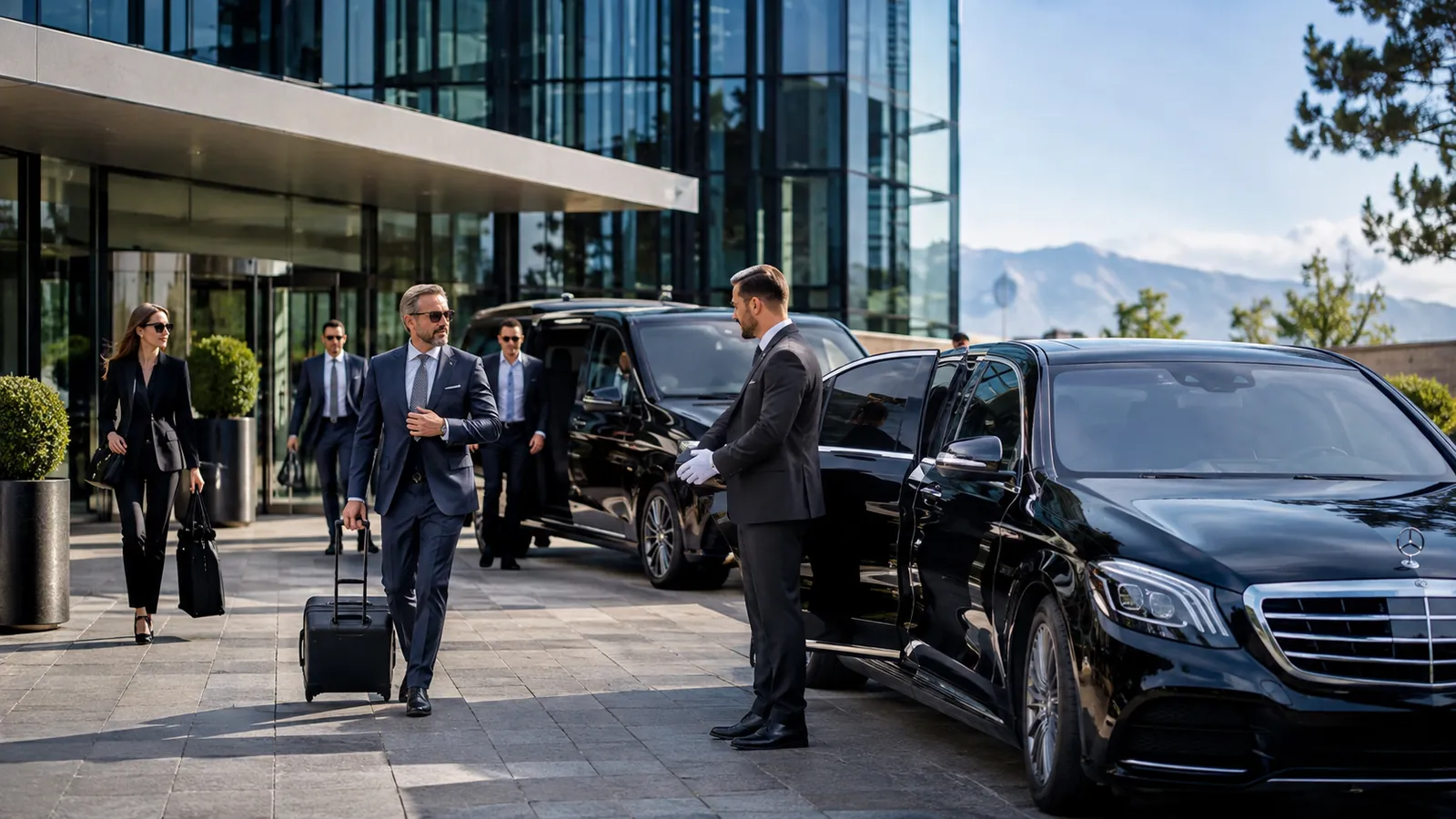
Companies and multinationals
Corporate Chauffeur Service in Geneva for Companies and Multinationals
For the people who organise other people's travel: visitors, leadership, teams and new arrivals.
- Absolute Discretion
- Premium Fleet
- Secure Payment
- Available 24/7
Book your chauffeur
- Mercedes Benz E-Class: 25 km included per booked hour, then 3.00 CHF per extra km.
- Mercedes Benz S-Class: 25 km included per booked hour, then 6.00 CHF per extra km.
- Mercedes Benz V-Class: 25 km included per booked hour, then 3.60 CHF per extra km.
Add all your stops: the route is calculated by Google Maps and any extra kilometres are added to the price.
NB : Each time you change the information you will need to press the Price Estimate button.
A corporate chauffeur service in Geneva: organising other people's travel
In a company, the person who orders a car is seldom the one who sits in it. It is an executive assistant, a facilities manager, a human-resources officer or an internal events organiser, and that is the person who will be held to account if the visitor is left standing on the pavement. A corporate chauffeur service in Geneva is therefore designed first for that organiser: clear information, readable rates, contacts who can be reached and cars that turn up where they are expected.
Geneva Chauffeur Service is open to companies of every size, from a twenty-person subsidiary to a group's regional headquarters. Here you will read about the situations we handle most often, the geography of business sites around Geneva, the way to coordinate several vehicles and the rules that apply to changes.
What a company should know from the outset
- Price Transfers from CHF 100. Hourly hire: CHF 100 per hour, 2 hours minimum (CHF 200). Prices in a Mercedes E-Class
- Ordering for a third party You reserve, your visitor travels; each receives the information that concerns them
- Fleet E-Class and S-Class saloons, V-Class vans, Sprinter minibuses
- Arrivals by air Welcome in the hall with a board, flights tracked, one hour of waiting after landing
- Budget Rate for each ride displayed before confirmation
- Settlement Bank card online, company cards too
- Availability Day and night, weekdays and weekends, by reservation
- Contact Telephone, e-mail and WhatsApp
Who reserves, who travels, who settles
Three roles intersect in a business trip, and telling them apart prevents most misunderstandings.
The organiser places the order. He or she knows the programme, the internal constraints and the pecking order of the visitors. That is the person we warn when something unexpected happens, unless instructed otherwise.
The passenger needs only the essentials: where to find the chauffeur, at what time, and which number to call. We take care not to bother travellers with housekeeping questions.
The payer is sometimes a third person, the one who holds the company card or signs off expenses. Because the amount is known before the order, it can be approved upstream, not discovered afterwards on an expense claim.
Seven situations every company comes across
The visit by group leadership
Three or four members of the executive committee fly in from abroad for two days. Their flights do not coincide, nor do their hotels. A car is needed for each arrival, a van to move them together to the site, saloons for the dinners. The organiser sends a single table; we translate it into as many rides as necessary.
The board meeting and the general meeting
Directors are expected at a fixed hour and often leave the same day. Their punctual arrival determines whether the session can open. Each pick-up is therefore keyed to the real flight, and the return to the airport is planned with a margin that allows for the end of the proceedings, which is seldom exact.
Welcoming a client or a supplier
Collecting a client straight off the plane says something about the relationship you wish to maintain. The chauffeur holds a board with the visitor's name or your company's, drives the guest to your offices and then, in the evening, to the restaurant and the hotel.
The arrival of an expatriate employee
A manager transferred to Geneva often lands with a family and far more luggage than an ordinary traveller. A van, seats suited to the children's ages, supplied free on request, and a chauffeur who helps to load everything turn a trying arrival into a pleasant first contact. In the days that follow, a car kept by the hour makes it possible to view homes or the campuses of the International School, at La Grande Boissière, near the Nations or in Founex.
The offsite
A team goes away to think for two days by the lake or in the mountains. Megève and Chamonix are about 1 h 20 from the airport, Villars about 1 h 40, Crans-Montana about 2 h 30. A Sprinter minibus keeps the group together; beyond its capacity, several vehicles travel in step.
Visiting auditors, consultants and trainers
These outside contributors move from one assignment to the next and do not know the city well. A reserved ride between the airport, their hotel and your site saves them from losing the first hour of their engagement.
The company evening
Year-end party, retirement send-off, product launch: when the employer organises the evening, thinking about the journey home falls to the employer too. Vehicles stationed at the exit, at staggered times, take everyone back without anybody getting behind the wheel after a toast.
The business clusters around Geneva
Geneva's economic fabric is organised into several clusters, each with its own access routes and difficult hours.
- Airport, Cointrin, Grand-Saconnex. Office buildings, the Palexpo congress centre, business hotels. Five minutes from arrivals, but congested on trade-fair days.
- Meyrin and Satigny. The industrial zone known as ZIMEYSA, watchmaking and technology sites, CERN close by.
- Plan-les-Ouates. The ZIPLO industrial zone, where watch manufactures and life-science companies are concentrated. Direct access from the bypass motorway.
- Praille, Acacias, Vernets and Lancy-Pont-Rouge. A former warehouse district in full transformation, now lined with bank headquarters and recent office buildings, with a Léman Express station.
- Sécheron and the Nations. International organisations, permanent missions, life sciences.
- The centre. Banks, law firms, trading, luxury retail.
- La Côte, in Vaud. Between Nyon and Morges, along the A1 motorway, many international groups have set up their European headquarters. Nyon is 26 km from the airport, Morges 50 km.
This scattering explains why a single day of visits can pass through three municipalities and two cantons. It also explains why public transport, laid out like a star around the main station, copes poorly with trips from one cluster to another.
Coordinating several vehicles
Once the visitors number more than three, the question is no longer “which car?” but “how many, and in what order?”. A few principles guide our answer.
Group by arrival wave. Two flights landing twenty minutes apart can share a van; two flights two hours apart cannot. Better one vehicle more than a vice-president kicking his heels in a hall.
Respect precedence. If internal protocol requires a given executive to travel alone or to arrive first, say so. The allocation of cars takes it into account.
Choose between a minibus and several saloons. A minibus simplifies the timetable and bonds the group. Saloons give flexibility if the participants leave at different times.
Appoint a lead contact. One person on the client side centralises the changes. Our chauffeurs, for their part, coordinate among themselves so as to pull up together.
An example: twelve visitors, three flights, a site in Plan-les-Ouates
One Tuesday morning, twelve people from three countries have to be gathered at 10.30 am in a meeting room in Plan-les-Ouates. Five land from London at 8.35, four from Frankfurt at 8.50 and three from Madrid at 9.20. The first two groups, close together in time, leave together in a Sprinter minibus at about 9.20. The third follows in a V-Class van at about 9.50. Twenty minutes on the road by the bypass motorway: everybody is on the premises a quarter of an hour before the start.
In the evening, departures are spread between 5 and 8 pm. Three vehicles leave the site at times keyed to each flight. The organiser sent a single document, the passenger list with flight numbers, and received in return the details of every pick-up. On the day she had one telephone number to ring, and in the event did not need to use it, which is how a well-prepared arrival usually goes.
Changes are part of the job
No corporate programme runs exactly as written. Some adjustments take care of themselves: a late or early plane is tracked, and the chauffeur adapts without your stepping in. Others call for a message: an altered flight, an extra passenger, an address that changes. Warn us by the fastest channel, quoting the date and the name on the reservation.
That leaves cancellations, for which the rules are the same for everyone and appear in our general terms. At 72 hours or more from the pick-up, the sum paid is returned in its entirety. Between 72 and 48 hours, half of it. Below that, or if the passenger does not come, nothing. These thresholds are worth knowing when you set the deadline by which your participants must confirm.
The calendar that weighs on your reservations
Vehicle availability in Geneva varies sharply from one week to the next, and an organiser gains from knowing the tight periods. The big fairs at Palexpo, first among them the spring watchmaking event, tie up saloons and minibuses for several days. May and June bring in the delegations of the major international conferences. The return to work in September packs board meetings, offsites and leadership visits together. Finally, from mid-December to the end of March, Saturdays are swallowed up by transfers to the ski resorts.
If your event falls inside one of those windows, settle the transport arrangements at the same time as the hotel and the meeting room, not last of all. Outside them, there is far more flexibility. A simple reflex helps: when you block the rooms, send us the provisional dates and headcount as well, even before the flight details exist, so that the vehicles can be pencilled in.
One city, two countries: the cross-border dimension
Few business centres are as interwoven with a neighbouring country. Some of your visitors will be staying in Ferney-Voltaire, Annemasse or Divonne; some of your sites may be located in the Pays de Gex or in Haute-Savoie. For our chauffeurs, going through the border is an everyday act. Two precautions are nevertheless in order. First, build into the timings the slowdowns in the morning and late afternoon at the main border posts. Second, if your staff are carrying demonstration equipment, samples or prototypes, check the customs formalities upstream: Switzerland is not part of the European customs union, and commercial goods must be declared.
The same closeness has an upside for programme planners. A dinner in a French village inn, a team-building afternoon on the Salève or a night in Annecy can be added to a Geneva meeting without anybody boarding a plane, and the vehicles that brought the group from the airport simply carry on.
Safety and duty of care
An employer answers for the safety of staff who are travelling. Entrusting their journeys to career drivers, at the wheel of insured and regularly serviced vehicles, is among the simplest responses to that obligation. The employee who lands at 11.30 pm does not have to go looking for transport; the one who has worked sixteen hours does not have to drive a hire car along a motorway he has never seen.
In winter the question becomes concrete. On French mountain roads, the Loi Montagne demands winter tyres or chains from 1 November to 31 March in the municipalities concerned. Our vehicles are equipped for the season when the route calls for it, and our chauffeurs are experienced on snow.
A readable budget
The rate for a ride is calculated from the route and the model; the rate for a car kept by the hour, from the duration. In both cases it appears before confirmation and does not vary with congestion. For a finance department, this means that a trip can be costed and approved before it takes place.
Our general terms leave any parking and toll costs with the client, unless the offer decides otherwise. Payment is made online, by card, when ordering; a written confirmation then summarises the service, the passenger's name and the company's if you supplied it.
Which car for which use
E-Class: the default choice for an employee or a consultant, alone or accompanied, between the airport, the hotel and the office.
S-Class: for a member of senior management, a board director, an important client, or for a long drive to Zurich or Basel.
V-Class: for a small team travelling together, for an expatriate family and its luggage, or for passengers who wish to talk face to face.
Sprinter: for a group, an offsite, or a shuttle between a hotel and a meeting venue.
When in doubt, describe the people and not the vehicle: who is travelling, with what, and how senior. The right model follows from that description far more reliably than from a guess at a category.
Setting up an ongoing relationship
Many companies begin with a one-off reservation, then come back. If your needs are regular, for instance weekly visitor arrivals or recurring shuttles between two sites, describe them to our team by telephone or e-mail: approximate volumes, typical routes, internal approval constraints. We will tell you the simplest way to proceed and the information to send us with each request.
One habit is worth adopting from the start: always use the same message template, with the passenger's name, flight number, the addresses and the person to notify. Mistakes nearly always stem from a missing piece of information, seldom from the road. A shared mailbox on your side, so that requests do not depend on one colleague's presence, is the other simple measure that pays for itself within a month.
Practical guide : Organising Ground Transport for Company Visitors in Geneva: A Seven-Step Method
Frequently asked questions
Frequently asked questions about corporate chauffeur services in Geneva
Can I reserve for a visitor from outside the company?
Yes. You give the visitor's name, mobile number and flights; your own details serve as the contact for organisation.
How does the visitor recognise the chauffeur?
At the airport he waits in the arrivals hall with a board showing the visitor's name or your company's, whichever you choose.
Can we settle with a company card?
Yes. Visa, Mastercard, Maestro and American Express are accepted; the online transaction is secured by Stripe.
Do we receive a written record of each order?
Yes, a written confirmation is sent to you after payment. It restates the particulars of the ride.
How many people can you carry at once?
That depends on the number of vehicles brought in. Send the headcount and the timings: we will suggest the right combination of saloons, vans and minibuses.
What should we do if a participant changes flight the day before?
Pass on the new flight number as soon as you have it. The pick-up is tied to the new timing, subject to availability.
Do flight delays lead to an additional cost?
No: the real arrival time is tracked and sixty minutes of waiting after landing are provided at no extra charge.
Do you run shuttles between a hotel and our site over several days?
Yes. Give the daily timings and the number of people; a minibus or a van is assigned to these rotations.
Do your chauffeurs speak English?
Yes. They speak several languages and welcome foreign visitors daily.
Do you serve sites in the canton of Vaud?
Yes: Nyon, Gland, Rolle, Morges, Lausanne and Vevey are everyday destinations from Geneva Airport.
Do you offer a contract or special conditions for regular needs?
Set out your requirement to the team. We will look with you at the way of proceeding best suited to your volumes.
How much notice is needed to reserve a series of cars?
The larger the request, the further ahead you need to plan. For ten or so vehicles during a trade fair, allow several weeks; for a single car, a few days are often enough.
Can only some of the rides be cancelled?
Yes. Each ride follows its own cancellation conditions, according to the time separating it from its date.
How do you deal with night arrivals?
Like any others. The service runs at all hours, provided the ride has been reserved.
Do you supply seats for the children of an expatriate family?
Yes, free of charge and on request. State each child's age.
Can the chauffeur stay with our visitors all day?
Yes, with the hourly formula, from two hours upwards. The same car drives them from one site to another and waits for them.
Whom do we alert in an emergency on the day?
Ring the number on your confirmation or write on WhatsApp. It is the quickest way to reach the team and, through it, the chauffeur.
Ready to book your chauffeur?
Get your price online in a few seconds, or contact us on WhatsApp — we answer 24/7.