
Business travel
Executive Chauffeur in Geneva for Business Travel
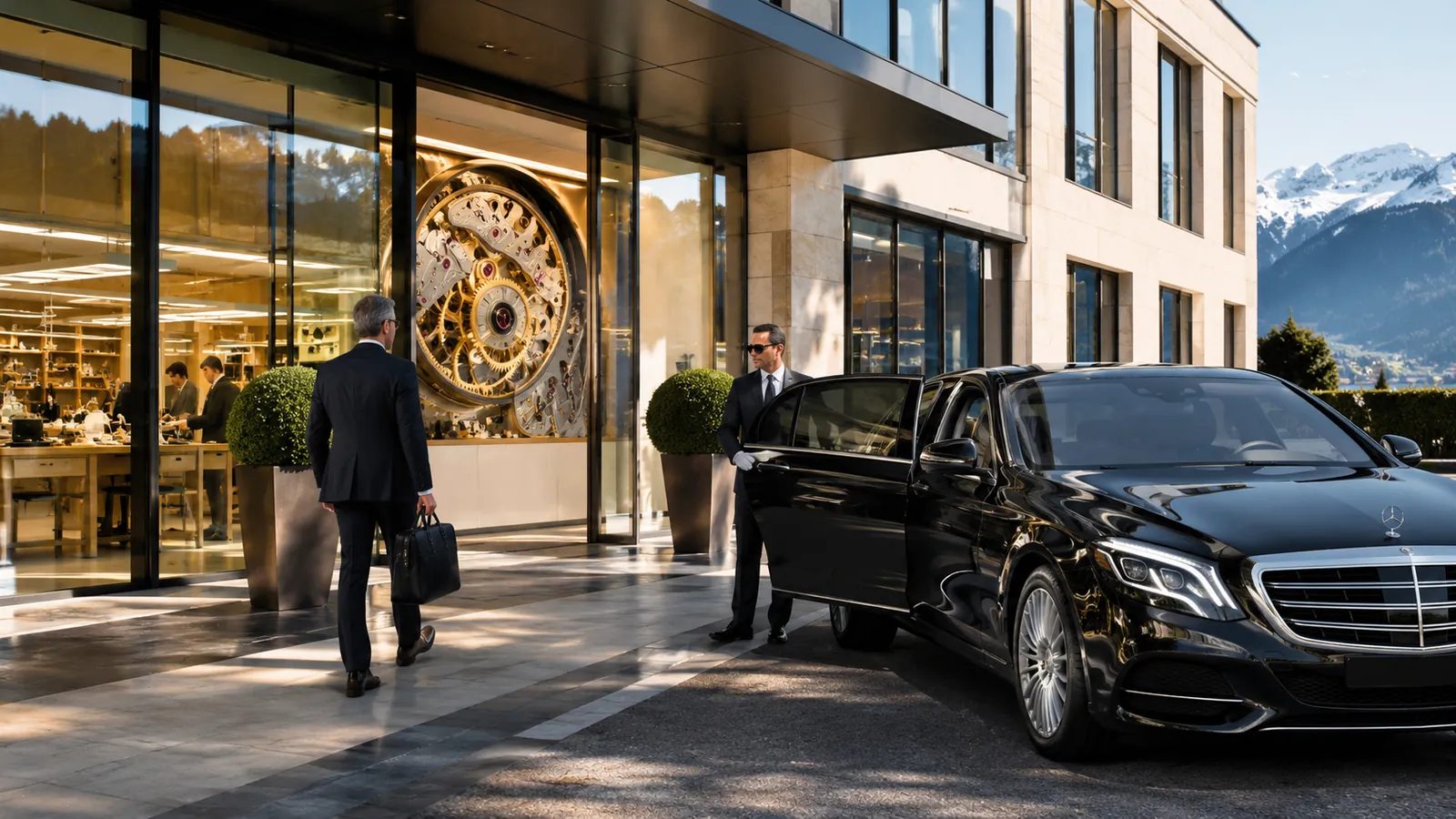
A saloon, a punctual and discreet chauffeur, and hours on the road that become working hours again.
- Absolute Discretion
- Premium Fleet
- Secure Payment
- Available 24/7
Book your chauffeur
- Mercedes Benz E-Class: 25 km included per booked hour, then 3.00 CHF per extra km.
- Mercedes Benz S-Class: 25 km included per booked hour, then 6.00 CHF per extra km.
- Mercedes Benz V-Class: 25 km included per booked hour, then 3.60 CHF per extra km.
Add all your stops: the route is calculated by Google Maps and any extra kilometres are added to the price.
NB : Each time you change the information you will need to press the Price Estimate button.
An executive chauffeur in Geneva for diaries with no slack
A chief executive spending a day in Geneva has not come to admire the Jet d'Eau. There is a board to chair, a mandate to negotiate, a regulator to meet and then a plane to catch. The job of an executive chauffeur in Geneva is to make sure that nothing between those obligations costs any attention: not the address to find, not the clock to watch, not the parking space to hunt for.
Geneva Chauffeur Service provides senior managers, partners and entrepreneurs with Mercedes saloons driven by seasoned professionals. The lines below describe the economic map of the city, the most common trip formats, the links to the other Swiss business centres and the customs that separate executive transport from an ordinary ride.
The service in a few markers
- Price Transfers from CHF 100. Hourly hire: CHF 100 per hour, 2 hours minimum (CHF 200). Prices in a Mercedes E-Class
- Who it is for Executives, partners, board members, managers on the move
- Formats Ride from one address to another, car kept by the hour from two hours, city-to-city link
- Saloons Mercedes E-Class and S-Class; V-Class for a team
- Airport Named welcome in the hall, flight monitored, an hour's leeway after landing
- Languages Polyglot chauffeurs well used to international visitors
- Reserve No conversation leaves the car
- Hours Every day, very early and very late too, to order
The business map of Geneva, district by district
To drive professionals you need to know where they work. This is how the main activities are spread out.
Banking and wealth management
Geneva finance was born between Place Bel-Air, Rue de la Corraterie and Rue du Rhône, in a perimeter that is in fact called the Quartier des Banques. Several institutions have nonetheless moved their teams to Les Acacias and La Praille, on the far side of the River Arve. An appointment “at the bank” can therefore mean either of two addresses three kilometres apart: check which.
Commodity trading
Geneva ranks among the world's foremost centres for trading oil, grain, coffee and sugar. The trading houses, and the shipping firms that revolve around them, occupy buildings in the centre, in Eaux-Vives and along the quays.
International organisations and economic diplomacy
The World Trade Organization has its seat by the lake, at the Centre William Rappard; the World Intellectual Property Organization, the International Telecommunication Union and the Palais des Nations cluster around Place des Nations. Companies go there for consultations, arbitrations and sector negotiations.
Watchmaking and industry
The manufactures and their suppliers are found in the industrial zones of Plan-les-Ouates and Meyrin-Satigny. They are reached by the bypass motorway, without going through the centre.
Science and technology
CERN sprawls across Meyrin, astride the border. Campus Biotech, in the Sécheron district, brings together researchers and young life-science companies. As for the surroundings of the airport, they hold office buildings favoured by firms whose staff travel a great deal.
The car as an extension of the office
An hour spent in the back of a saloon is not an hour lost. You can reread a presentation there, prepare a meeting with a colleague, or make the call you would not have dared to hold on a train. The cabin of a large Mercedes is quiet enough for a conference call, and the chauffeur knows it is none of his business.
It is also, for many of our passengers, the only moment of the day when nobody is asking them for anything. Closing your eyes for twenty minutes between two sessions is one of the legitimate uses of a chauffeur-driven car. You only have to say so: the driving becomes gentler still, and conversation can wait.
Travellers who cross time zones to reach Geneva know the value of this. After a night flight from the Gulf or the American east coast, the forty minutes between the terminal and a lakeside head office are the difference between walking into the room alert and walking into it dazed.
Three formats of business trip
The same-day return
In on the first flight, out on the last. In between, everything has to follow on. The car waits at the airport, delivers its passenger to the first appointment half an hour after landing, then either stays at his or her disposal or returns at the stated time. The cabin bag never leaves the boot.
The stay of several days
For a week of negotiation or a board session, regularity comes first. Each morning the traveller finds, as far as possible, the same chauffeur, who by now knows the timetable, the preferred entrance and the way to the hotel. Evening drives, to dinners and receptions, are added as the days go by.
The city-to-city link
Many programmes do not stop at Geneva: a head office in Vevey, an authority in Bern, a partner in Basel, a bank in Zurich. The saloon then serves as a private cabin on the A1 motorway, from the door of one building to the door of another.
Business links starting from Geneva
The distances below are measured from the airport; the times hold for normal traffic and allow a reasonable margin.
- Nyon: 26 km, about 25 minutes. Headquarters of UEFA and of many companies established on La Côte.
- Lausanne: 63 km, about 55 minutes. International Olympic Committee, EPFL, management schools.
- Vevey: 85 km, about 1 h 10. Nestlé's global headquarters.
- Neuchâtel: 123 km, about 1 h 35. Watchmaking and microtechnology.
- Fribourg: 139 km, about 1 h 45.
- Bern: 157 km, about 2 hours. Federal administration, embassies, supervisory authorities.
- Lyon: 153 km, about 2 hours, by the French motorway.
- Basel: 251 km, about 3 h 10. Pharmaceutical industry and major trade fairs.
- Zurich: 277 km, about 3 h 30. The country's leading financial centre.
- Zug: 288 km, about 3 h 35. Trading companies and holding structures.
- Milan: 329 km, about 4 h 35, through the Mont Blanc Tunnel.
Train, plane or car: choosing without prejudice
Switzerland has one of the finest railway networks in the world, and it would be bad faith on our part to claim that the car always wins. From Geneva station to Zurich station the train takes a little under three hours, with no traffic to worry about. For a lone traveller going from one city centre to the other, it is often the most rational choice.
The chauffeur-driven saloon comes out ahead in other configurations. When the destination address is far from a station, such as an industrial site or a head office on the outskirts. When the day involves several stops, say Lausanne in the morning and Bern in the afternoon. When two or three colleagues need to prepare a meeting together without being overheard by their neighbours. When files, prototypes or samples are being carried. When the return is late, after a dinner, at an hour when connections thin out.
As for flying between Geneva and Zurich, the flight itself is brief, but check-in, security and the drives to and from both airports wipe out a good part of the advantage. Our honest advice is therefore to compare door-to-door times rather than timetable times, and to count what you can actually get done during each of them.
Punctuality is manufactured the day before
Arriving on time is not a matter of speed. The day before, the chauffeur studies the programme: he identifies the exact entrance to the building, the place where he will be able to pull up, and the driving time at the hour in question. He sets a departure time that absorbs an everyday slowdown, without making his passenger leave half an hour too soon.
On the day itself, the car is in position a few minutes before the agreed time. On the road, the chauffeur keeps an eye on traffic conditions and knows the fallback routes: a different bridge, the lake road in place of the motorway, another border post. At the airport, flight tracking replaces guesswork, and the hour of waiting provided after landing covers the longest of checks.
If a delay looms in spite of everything, the passenger is told early enough to warn the person waiting. In a country where exactness is a form of courtesy, that information is worth almost as much as the minutes themselves.
Discretion: a rule of the trade
An executive chauffeur overhears names, figures and hesitations. The rule has no shades of grey: nothing said on board is repeated, commented on or remembered. He does not question his passenger about the purpose of the visit and never mentions the people he has driven before.
Discretion extends to what can be seen. At the airport, the board may show just a surname, initials or a company name, according to what you specify when ordering. Outside a building, the car stops where it is asked to, a side entrance included. Finally, the chauffeur publishes nothing and photographs nothing: your chairman's visit will not surface on any social network through him. For visits that are sensitive for market or personal reasons, tell the team so plainly when ordering, and the arrangements for arrival and departure will be thought through with that in mind.
Protocol and customs
Receiving a high-ranking visitor follows a few conventions which our chauffeurs apply without needing to be reminded. The seat of honour is rear right, on the kerb side; that is the door the chauffeur opens first. When a host accompanies a guest, the host sits to the guest's left. The chauffeur greets, introduces himself briefly, confirms the destination and thereafter speaks only when spoken to.
Luggage is carried and stowed by him. For a delegation spread across several cars, the order of departure and arrival can be fixed beforehand, so that the most senior person is neither the first to wait nor the last to get out.
E-Class, S-Class or V-Class: which car for which trip
The E-Class is the working saloon: comfortable, understated, at ease in town. It suits urban rides, airport arrivals and one-hour links.
The S-Class is the obvious choice for long runs and for passengers who work or rest on board. More legroom, superior soundproofing, and road manners that take the fatigue out of three hours of motorway. It is also the car you send for a chairman, or for a client you wish to honour.
The V-Class proves useful when a management team travels together: people sit face to face, which turns the drive into a preparatory session.
For executive assistants
You are organising somebody else's trip and you answer for the result. Ten lines are enough for the day to unfold as planned:
- the passenger's name as it should appear, or not appear, on the board;
- the traveller's mobile number and your own;
- the flight or train number;
- full addresses, with the name of the company visited and the floor or reception desk;
- mandatory times and indicative times;
- the model wanted;
- the number of people and bags;
- the traveller's language;
- known preferences: silence, a discreet entrance, a stop on the way;
- the person to alert if anything changes.
The order can be placed in your name on the passenger's behalf, with the company's name entered in the field provided. A written confirmation reaches you; you can forward it to the traveller as it stands.
A concrete case: thirty-six hours in Geneva
The chief executive of an industrial group lands on a Tuesday at 5.50 pm. His chauffeur is waiting in the hall and delivers him to his hotel on Quai des Bergues at 6.35 pm. At 7.45 pm the same S-Class takes him to a dinner in Cologny, then brings him back at around 11 pm.
On Wednesday, departure at 7.30 am for Vevey, where a session begins at 9. The road runs alongside the lake; he uses the time to go over his notes. At 1 pm, back towards Geneva with a stop in Lausanne for a working lunch. At 4 pm, a final appointment near Place des Nations. At 6.15 pm, drop-off outside departures, in time for the 7.40 pm flight. Two rides on Tuesday, a car by the hour on Wednesday: three reservations, one chauffeur. Nothing in that programme is exceptional, and that is precisely the point: the logistics stayed in the background from the first handshake in the arrivals hall to the last suitcase lifted out at departures.
Rate, settlement, changes and cancellation
The rate is established beforehand: by route and model for a ride, by duration for a car kept by the hour. It appears in the form before confirmation and does not depend on the vagaries of traffic. In accordance with our general terms, parking and toll costs remain owed by the client, unless the offer provides differently.
Payment takes place online, by card, when the order is made. For a change of time or address, a message by e-mail, telephone or WhatsApp is enough, as early as possible. Cancellation is free until 72 hours before the pick-up; it entitles you to 50% between 72 and 48 hours; it entitles you to nothing after that, any more than a failure to turn up does.
Practical guide : Business Trip to Geneva: Districts, Calendar and Getting Around
Frequently asked questions
Frequently asked questions about executive chauffeurs in Geneva
How does an executive chauffeur differ from a standard transfer?
In preparation and customs: scouting the access, a calculated margin, a welcome protocol, absolute reserve about what is said on board. The car and the rate follow the same principles.
Can I work or make calls during the drive?
Yes. The cabin of a Mercedes saloon is calm, and the chauffeur takes no part in your exchanges.
Does the chauffeur sign a confidentiality undertaking?
Discretion is one of his professional obligations. If your company requires a particular document, raise it with the team before the service.
Will I have the same chauffeur throughout my stay?
We do our utmost once you have given us the whole programme. It is easier to secure when the reservations are made in one go.
What should be written on the board at the airport?
Whatever you wish: full name, surname alone, initials or company. Specify it in the remarks.
How long does it take to drive from Geneva to Zurich?
About 3 h 30 for 277 kilometres from the airport, on the A1 motorway, outside rush hour.
Can Lausanne and Bern be combined on the same day?
Yes. Lausanne lies about 55 minutes from Geneva and Bern about an hour and ten minutes from Lausanne; a car kept for the day is the fitting formula.
Do you handle departures before 6 am and returns after midnight?
Yes, the service runs at any hour provided the ride has been reserved.
Can my assistant reserve and pay in my place?
Certainly. He or she gives your name as the passenger and his or her own details as the contact.
Which cards are accepted?
Visa, Mastercard, Maestro and American Express. Online payment is processed by Stripe.
E-Class or S-Class for a Geneva–Bern drive?
Either will do. If you intend to work or rest for two hours, the space and silence of the S-Class make a real difference.
My morning flight is often late. How does the chauffeur adapt?
He relies on the actual landing time, which we follow, and has sixty minutes of waiting counted from it.
Can you drop a passenger at the business aviation terminal?
Yes. Give the operator's name and the planned flight time; this service is detailed on our page devoted to private jets.
How do I push back a pick-up if my meeting runs over?
Warn the chauffeur or the team as soon as you know. For a single ride, the postponement depends on his schedule; with a car by the hour, he simply waits.
Do you drive as far as Milan or Lyon?
Yes. Lyon is about 2 hours away, Milan about 4 h 35 through the Mont Blanc Tunnel.
What if I have to cancel the day before?
Inside 48 hours the service remains due under our general terms. Do let us know all the same, so that the chauffeur does not turn out for nothing.
Can several cars be arranged for a delegation?
Yes. Give us the number of travellers, how you would like them divided up and the order of arrival; the vehicles are then coordinated so as to travel and pull up together.
Ready to book your chauffeur?
Get your price online in a few seconds, or contact us on WhatsApp — we answer 24/7.