
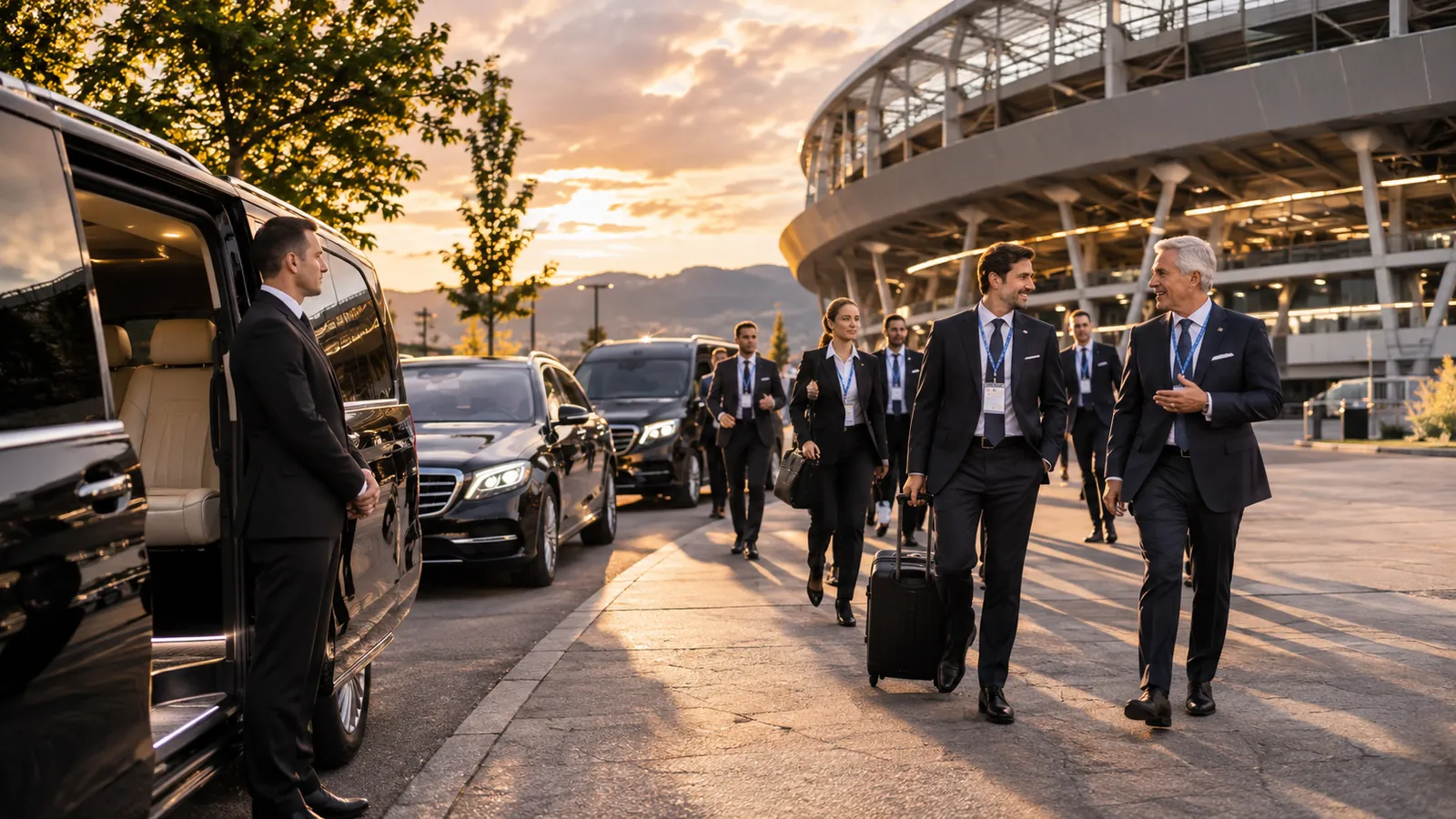
Congresses, fairs, seminars
Event Chauffeur in Geneva: Congresses, Trade Fairs and Seminars
From the first airport arrival to the last ride home after the gala, a transport plan that holds for your delegates, speakers and guests.
- Absolute Discretion
- Premium Fleet
- Secure Payment
- Available 24/7
Book your chauffeur
- Mercedes Benz E-Class: 25 km included per booked hour, then 3.00 CHF per extra km.
- Mercedes Benz S-Class: 25 km included per booked hour, then 6.00 CHF per extra km.
- Mercedes Benz V-Class: 25 km included per booked hour, then 3.60 CHF per extra km.
Add all your stops: the route is calculated by Google Maps and any extra kilometres are added to the price.
NB : Each time you change the information you will need to press the Price Estimate button.
Event chauffeur in Geneva: transport is the first and last impression of an event
Delegates do not always remember the third speaker of the morning. They do remember standing outside a terminal for forty minutes, or being greeted by name as they came through customs. The job of an event chauffeur in Geneva lies in that gap: making sure the journey is never the thing people talk about over coffee.
Geneva Chauffeur Service provides Mercedes saloons, vans and minibuses, each with its chauffeur, to the people who organise: event agencies, professional congress organisers, communications departments, executive assistants, and the associations and federations that bring their members together beside the lake. This page describes how we work, venue by venue and stage by stage, so that you can judge whether it fits your event. It is written for the person who holds the spreadsheet, not for the passenger.
Key points for organisers
- Price Transfers from CHF 100. Hourly hire: CHF 100 per hour, 2 hours minimum (CHF 200). Prices in a Mercedes E-Class
- For Congresses, trade fairs, company conventions, seminars, launches, gala evenings, incentive trips
- Services Airport and station welcomes, hotel-to-venue journeys, cars at your disposal by the hour from 2 hours, excursions
- Vehicles Mercedes E-Class and S-Class, V-Class van, Sprinter minibus; several vehicles coordinated when needed
- At the airport Flights tracked, name sign in the arrivals hall, 60 minutes of waiting covered after landing
- Hours Day and night, every day of the week, by reservation
- Organisation A single contact for the whole programme, and an offer drawn up from your list of journeys
Each event format has its own pattern of journeys
The congress or international conference
Several hundred people arrive over two days, on flights from everywhere, and stay in ten different hotels. Not all of them need a car: many will take the train or the tram. Those for whom the organiser books a chauffeur are usually the speakers, committee members, sponsors, guests of honour, and anyone with reduced mobility or a great deal of luggage. The work lies in identifying them early and giving each one a named welcome.
The trade fair
Here the need shifts to the exhibitors. A sales team staffs a stand for four or five days, receives clients, takes them to dinner and runs a director back to the airport between two appointments. A car at the team's disposal, parked close to the halls, serves everyone; a van links the hotel and the fair morning and evening.
The company convention and the seminar
The group is known and so is the programme, although it often changes until the day before. Journeys are collective: airport to hotel, hotel to plenary room, room to restaurant. Minibuses carry most of the movement, while one saloon is kept for senior management or for the outside speaker who leaves before the end.
The product launch and the gala evening
Everything happens within a short window. Guests arrive within twenty minutes, step out at an entrance with room for only two vehicles at a time, and want to leave when they decide to. It is the most demanding exercise for chauffeurs: order of arrival, a quick drop-off, waiting at a distance, returning when called.
The incentive trip
A team invited to Geneva for three days has not come to work. Transport becomes part of the programme: the road through the Lavaux vineyards, lunch in Gruyères, a day in Chamonix facing Mont Blanc, an evening in Montreux. The chauffeur knows the stops and how long it really takes to link them.
Geneva's event venues, seen from the driver's seat
Knowing an address is not enough; you need to know which way in to use, where a vehicle may stop and how long it takes to get away at six in the evening.
Palexpo, in Le Grand-Saconnex, is the canton's exhibition and congress centre: seven halls and more than a hundred thousand square metres, right beside the airport and its railway station, about ten minutes on foot from the terminal. That proximity sometimes misleads organisers. A visitor without luggage can walk, but an exhibitor carrying demonstration cases, a guest expected at a precise time or a party of twelve are far better off being dropped at the right entrance. That entrance changes from one fair to the next, as do the authorised drop-off areas, so please send us the access plan issued by the fair's organiser.
The Centre International de Conférences Genève (CICG), on Rue de Varembé, stands a short walk from Place des Nations, in the middle of the international organisations. The district is dense and closely watched, and stops there are brief. From the airport, the Route des Nations, opened in 2024 and largely underground, now links the Grand-Saconnex motorway junction to this area.
Hotels with conference rooms fall into two groups: those on the right bank, lined up along the quays and in the Nations district, and those around the airport, chosen for one-day meetings after which everyone flies home in the evening.
Evening venues are mostly in the centre and on the left bank: the Bâtiment des Forces Motrices, set on the Rhône, the Grand Théâtre and Victoria Hall near Place de Neuve, and the estates of the Geneva countryside for summer dinners. None of them was designed for forty cars arriving at once, which is why an order of arrival matters.
CERN, in Meyrin, receives visiting delegations and scientific events; it sits on the French border, on the far side of the airport from the city centre.
Around the lake, several centres host events whose participants land in Geneva: the SwissTech Convention Center on the EPFL campus near Lausanne, the Montreux convention centre, and the Palais Lumière in Évian. From the airport, allow about 55 minutes to Lausanne (63 km), about 1 hour 15 to Montreux (93 km) and about 1 hour 10 to Évian (52 km).
Arrivals, shuttles, departures: the three moments that decide everything
Arrivals
Your participants' flights are tracked, so a chauffeur does not turn up at the time printed on the ticket but at the actual landing time. He waits in the arrivals hall with a sign, bearing either the passenger's name or the name of your event, as you instruct, and takes care of the luggage as far as the vehicle. Sixty minutes of waiting after landing are covered, which allows for passport control and baggage delivery.
When several participants land within the same half-hour, it often makes sense to put them together in a van rather than send three saloons. The decision is yours: some guests travel alone as a matter of principle.
Shuttles during the event
Between the hotel and the venue, the need repeats itself: a group departure in the morning, a return in the evening, sometimes a rotation at lunchtime. A Sprinter minibus or a V-Class van booked by the hour runs these trips. For speakers whose timetable is out of step with the group, a saloon at their disposal means they do not depend on the collective schedule.
Departures
This is the tensest moment, because everybody wants to leave at once and flights do not wait. The rule we apply is simple: the departure time from the hotel or the venue is worked out backwards from the flight time, counting the check-in time required by the airline, the length of the drive and a margin for late-afternoon traffic. A participant leaving Palexpo is a few minutes from the terminal; one who sets off from the left bank at 5.30 pm has the whole city to cross.
Building the transport plan: a six-step method
- 1. The passenger list. A spreadsheet is enough: name, mobile number, flight or train number, date, hotel. It is the reference document, the one that gets corrected until the day before.
- 2. Sorting by level of service. Who travels alone in a saloon, who can share a van, who takes the train. This step shapes the budget far more than the choice of vehicles does.
- 3. Grouping by time slot. Arrivals are sorted by landing time; those that fall in the same window are combined where passengers will accept it.
- 4. Meeting points. The arrivals hall for flights, a precise entrance for hotels and venues. A place such as Palexpo has several ways in: a vague label costs everyone ten minutes.
- 5. Margins. Morning and late-afternoon rush hours, crossing the Mont Blanc bridge, closing time at a fair: each journey is given a realistic duration, not the one that applies on a Sunday morning.
- 6. The information loop. One person on the organiser's side and one person on ours exchange the changes. Chauffeurs receive the current version; participants receive, from you, the time and place of their pick-up.
On the basis of that list we draw up an offer for the entire programme, so you know what the whole arrangement costs before you commit to it.
Which vehicle for which role
At an event, vehicles are chosen by function rather than by taste.
- The Mercedes S-Class carries the guest of honour, the chairman, the keynote speaker. Its rear-seat comfort also makes it the car for longer runs to Lausanne or Montreux.
- The Mercedes E-Class is the working saloon: speakers, committee members, sponsors, one to three people with their cases.
- The Mercedes V-Class serves small groups, stand teams and combined arrivals. Its boot swallows the demonstration kit, roll-up banners and boxes of brochures that will not fit in a saloon.
- The Mercedes Sprinter handles shuttles and group outings. When numbers exceed its capacity, several vehicles travel together.
Always give the number of people and the true volume of luggage: after a trade fair, suitcases are heavier than on the way out.
The Geneva calendar: the weeks when the city is full
Geneva is a small city that hosts very large gatherings. In certain weeks the hotels are full as far as Nyon and across the French border, and chauffeur-driven vehicles are booked a long time ahead.
- In spring, the Watches and Wonders watch fair takes over Palexpo and draws brands, retailers and press from all over the world.
- In May, the World Health Assembly brings together the delegations of the WHO's member states.
- In June, the International Labour Conference is held in the Nations district, and the EPHJ fair gathers the suppliers of watchmaking and microtechnology at Palexpo.
- In December, the Geneva international horse show, the CHI, moves into Palexpo.
- All year round, sessions of the international organisations fill the area around Place des Nations in waves of a few days.
If your event falls in one of these periods, there are two practical consequences: book vehicles as soon as the dates are settled, and allow longer journey times around the airport and the Nations district.
Dinners, galas and late returns
The evening is when the organiser loses control of the clock: dinner runs on, one group wants an early night, another carries on elsewhere. Hourly hire is the answer to that uncertainty. Vehicles stay close by and the returns happen in waves, at the guests' pace, rather than at an imposed time.
For the arrival, we recommend staggering hotel departures at five-minute intervals when the venue's entrance is narrow. For the return, a single meeting point, clearly announced during dinner, saves guests from hunting for their car in the dark. As the service runs at any hour by reservation, a return at 2 am is planned like any other; it only needs to appear in the programme.
Leaving Geneva: excursions and incentive programmes
Participants who have come a long way want to see something other than a plenary room. From Geneva Airport, in normal traffic:
- Nyon and its castle by the lake: 26 km, about 25 minutes
- Annecy, its old town and its lake: 46 km, about 50 minutes
- Lausanne and the Olympic Museum: 63 km, about 55 minutes
- Vevey and the Lavaux terraces, a World Heritage site: 85 km, about 1 hour 10
- Chamonix, at the foot of Mont Blanc: 90 km, about 1 hour 25
- Gruyères, its medieval village and its cheese dairies: 120 km, about 1 hour 35
Hourly hire suits these outings: the vehicle waits on site and the group leaves when the visit is over. For France, remind participants to keep their passport or identity card with them, as the border is crossed in both directions.
When the programme changes
It always does. A flight is cancelled, a speaker brings his departure forward, the plenary overruns by half an hour. Some changes are absorbed without difficulty: a delayed flight is tracked and the welcome moves with it; a meeting that runs on is no problem when the vehicle is booked by the hour, provided you warn us if the planned duration is likely to be exceeded.
Others need to be anticipated. A participant added the evening before assumes a vehicle is still free, which cannot be taken for granted during a major fair. A change of pick-up point has to reach the chauffeur, not only the passenger. Hence the value of a single channel: everything goes through your contact on our side, by phone, e-mail or WhatsApp, and the reference list is updated every time.
Booking, payment and conditions
A single transfer can be booked directly online: the price is displayed for each vehicle before payment. For a complete programme, send your list of journeys and you will receive a detailed offer.
Payment is made in advance, by card, on a secure payment page. The booking can be placed in the name of your company or agency, with the name and mobile number of each passenger.
Two points in our terms and conditions concern organisers directly. Parking charges and any road charges are not part of the journey price unless the offer says so. And the cancellation scale is fixed: nothing is withheld if you cancel at least 72 hours before the journey, half is refunded between 72 and 48 hours, and nothing below 48 hours or if the passenger does not show up. For an event, that means it is wise to freeze the list three days before the first arrival.
Frequently asked questions
Frequently asked questions about event transport in Geneva
How far ahead should we book for an event?
As soon as the dates and the venue are known. The list of names can follow later; what matters first is the approximate number of vehicles and the days concerned, especially if a major fair is taking place at the same time.
Can you handle several dozen arrivals on the same day?
Yes, provided we receive the flight list early enough. Arrivals are allocated by time slot and by vehicle, and each chauffeur knows the names of the passengers he is waiting for.
Where do participants find their chauffeur at the airport?
In the arrivals hall, just beyond baggage reclaim and customs. The chauffeur holds a sign showing the passenger's name or the name of the event.
Can the sign show the name of our event or company?
Yes. State the exact wording in your request; for a well-known guest it is often more discreet than a personal name.
What happens if a speaker's flight is delayed?
The chauffeur adjusts his arrival to the actual landing, since the flight is tracked. The hour that follows landing is part of the service.
Is a car really needed between the airport and Palexpo?
Not for everyone: the walk takes about ten minutes. A car makes sense for an expected guest, someone heavily laden, a group to be dropped at a specific entrance, or a person who has difficulty walking.
Do you run regular shuttles between a hotel and the congress venue?
Yes, with a van or minibus booked by the hour, which makes the return trips at the times you set.
Can a car be kept at a stand team's disposal all day?
Yes. Hourly hire starts at two hours and extends as long as required. The stand team calls the chauffeur whenever it needs him.
Which vehicles for a group of twenty or thirty people?
Several vehicles travelling one behind the other: Sprinter minibuses and V-Class vans. Give us the exact headcount and the amount of luggage and we will put the arrangement together.
Do you work with agencies and professional congress organisers?
Yes. The agency remains the sole instructing party: it sends the list, receives the offer and passes the times on to its participants.
How should we send the passenger list?
By e-mail, in a table giving each person's name, mobile number, flight or train, date and destination address. Updates follow the same route.
Do the chauffeurs speak English?
Yes. They are used to foreign visitors and speak several languages, French and English first among them.
Do you cover returns after a gala dinner, late at night?
Yes. The service operates at any hour by reservation. Tell us the expected finishing time and keep the vehicles on hourly hire if it is uncertain.
Do you drive participants to Lausanne, Montreux or Évian?
Yes. These towns regularly host congresses whose participants land in Geneva; the journey is made in one go, with no change.
How is a programme of several journeys paid for?
By card, online and in advance: Visa, Mastercard, Maestro and American Express are accepted, with payment processed by Stripe.
What if a participant cancels?
It depends on the notice given. Up to 72 hours before the journey the amount is refunded in full; between 72 and 48 hours, by half; after that, or if the person does not turn up, it remains due.
Is parking at event venues part of the price?
No, unless the offer states otherwise: parking charges are borne by the client, as our terms and conditions provide.
Can you carry stand equipment?
Luggage and boxes that fit in the boot of a van, yes; mention them in your request. Bulky goods are a matter for a freight carrier.
Ready to book your chauffeur?
Get your price online in a few seconds, or contact us on WhatsApp — we answer 24/7.