
Practical guide
Arriving at Geneva Airport: Exits, French Sector and Transport into Town
Two exits, two countries and a railway station under the same roof: what to know before you land in Geneva.
Arriving at Geneva Airport: a simple airport with one subtlety
Geneva Airport, code GVA, which locals still call Cointrin, has a reputation for being easy: one main building, short distances and the city within reach. Yet it holds a surprise for first-time visitors: it opens on to two countries. This guide explains, in order, what awaits you between the aircraft door and your destination, and reviews every way of leaving the terminal without favouring any of them.
- City centre Roughly 4 km away
- Railway station Connected to the terminal; Cornavin in about seven minutes
- Exits Swiss side for most travellers, French sector for a few specific cases
- Currency Swiss franc; euros are often accepted, with change given in francs
- Motorway Vignette compulsory on the Swiss network
- Night No commercial flights between roughly midnight and 6 am
From the aircraft to the public hall
Switzerland belongs to the Schengen area: if you are coming from Paris, Madrid or Amsterdam, nobody looks at your passport. Coming from London, Dubai or New York, you go through an identity check before collecting your suitcases.
Switzerland is not, for all that, a member of the European Union. So a customs post remains, even for travellers arriving from a neighbouring country: green channel if you have nothing to declare, red if you do. The duty-free quantities of meat, alcohol and tobacco are limited; find out beforehand if you are carrying gifts of food and drink.
Swiss exit or French sector: how to choose
The baggage reclaim hall offers two directions. The main exit, by far the busier, leads to the arrivals hall on Swiss soil: trains, buses, taxis and chauffeur-driven cars all leave from there. The other route, signposted “France”, leads to the French sector, an enclave linked to Ferney-Voltaire by a customs road.
That sector is only of interest in two situations: you have reserved a hire car from an agency based on the French side, or someone is collecting you from the Pays de Gex and does not wish to enter Switzerland. In every other case, including a stay in Chamonix or Annecy, leave on the Swiss side. Transport is far more plentiful there, and the border is then crossed by road within minutes.
Six ways of leaving the airport
The train
The station is an extension of the terminal. Every train leaving it calls at Genève-Cornavin, the central station, after about seven minutes. Many carry on without a change to Lausanne, Bern or Zurich, others to Montreux and Valais. It is the quickest way into the heart of the city when you are travelling light.
The city bus
Several routes run by Geneva's public transport operator, TPG, stop outside the terminal. They are useful for districts the train does not serve directly, the international organisations quarter in particular. The ride takes longer and room for luggage is limited.
The taxi
Taxis wait outside the arrivals level. No reservation, a meter, and an immediate pick-up outside busy periods. On the big holiday getaway days the queue can grow long.
Ride-hailing apps
They work in Geneva. The driver meets you at a precise point shown in the app; the amount, announced when you order, climbs when demand is strong.
The pre-booked chauffeur
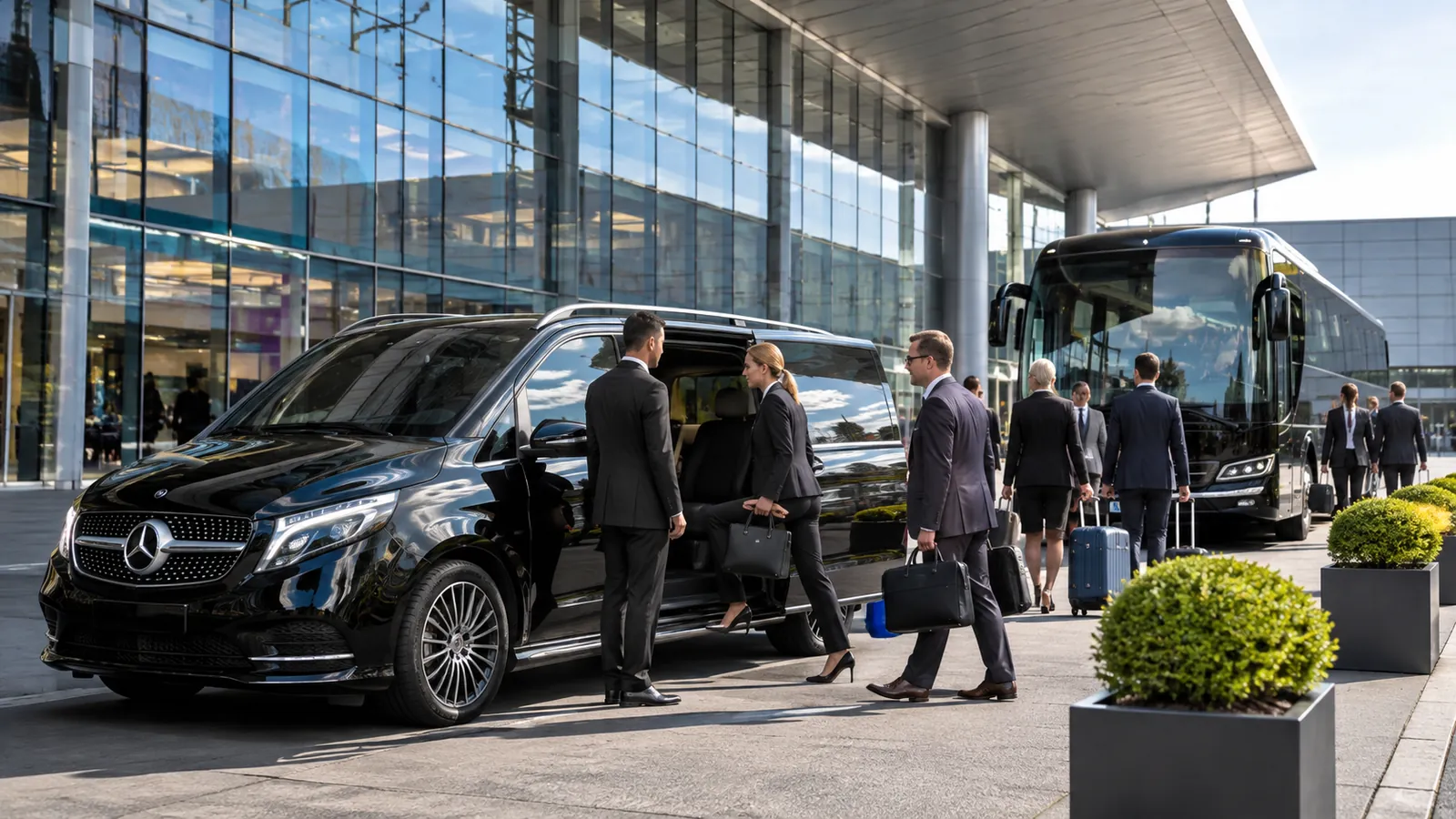
Ordered before the trip, he waits inside with a name board and already knows your address. The rate is fixed beforehand and the vehicle chosen to match the passengers and the luggage. It is the most comfortable formula with children, ski equipment, for a night-time arrival or for a destination outside the city.
The hotel shuttle
A few establishments near the airport run their own shuttle. Check the timetable with your hotel before relying on it.
Hiring a car: the traps to know about
Hire companies are present on both sides of the terminal, and the choice is not neutral. A car collected on the Swiss side carries the motorway vignette and, in winter, suitable tyres. A car collected on the French side sometimes costs less, but it does not necessarily have a vignette: you will need one to use the Swiss motorway, even for a few kilometres. It costs around forty francs for the calendar year and also exists in electronic form.
Second trap: returning the vehicle to the wrong sector often incurs a fee. Note the return route from the outset, because the French sector is reached by a separate road, from Ferney-Voltaire.
Lastly, if you are driving up to a resort on the French side between 1 November and 31 March, the Loi Montagne requires winter tyres, or chains carried on board, in the municipalities concerned. Put the question to the hire company.
Carrying on beyond Geneva
To Swiss cities, the train is often the best choice: Lausanne is reached in about fifty minutes without changing. To the ski resorts the situation is different. The French villages of Haute-Savoie and Savoie have no convenient rail link; people go up by coach, shared shuttle, hire car or with a chauffeur. On the Valais side, the train goes to Martigny, Sion or Visp, and a postal bus or mountain railway takes over from there.
By road and with no hold-ups, allow about an hour and twenty minutes for Chamonix, a little over two hours for Verbier and roughly two and a half hours for the Tarentaise resorts.
A few useful details
Swiss power sockets are type J, with three pins: flat two-pin European plugs fit them, bulky round ones do not, and British plugs need an adaptor. French is spoken in Geneva, and English is understood almost everywhere. Finally, the terminal and its railway station house Swiss-franc cash machines, exchange counters and a supermarket that opens on Sundays, handy before heading up to a chalet.
Frequently asked questions
Frequently asked questions
Do I have to go through the French sector to ski in Haute-Savoie?
No. Unless you are hiring a car on the French side, the Swiss exit is the more practical; you cross the border by car or coach a little further on.
How long does it take to reach the centre of Geneva?
About seven minutes by train to Cornavin. By car, a quarter of an hour to twenty minutes outside rush hour.
Can I pay in euros at the airport?
Often yes in the shops, but change is given in Swiss francs and the rate is not always favourable. Bank cards are accepted everywhere.
Is the Swiss vignette needed to drive to France?
Yes if you take the Swiss motorway between the airport and the border, which is the usual route. Cars hired on the Swiss side already have one.
Is the airport open at night?
Commercial flights stop between roughly midnight and 6 am. If you have to wait there, be aware that the shops close and public transport is scarce at those hours.
Is there passport control when arriving from London?
Yes, as the United Kingdom is outside the Schengen area. Allow extra time on winter Saturdays, when many British flights land at once.
Where is the railway station in relation to arrivals?
In the same complex of buildings, a few minutes' walk from the hall: follow the signs for the railway station.
More guides
-
Geneva Airport to Aix-en-Provence: How to Get There
An out-of-town TGV station, two road itineraries, door-to-door times: the journey from Geneva to Aix-en-Provence explained.
Read the guide
-
Geneva Airport to Aix-les-Bains: The Journey Guide
Direct train from Cornavin, the A41 or a chauffeur: the trip from Geneva Airport to Aix-les-Bains, with useful advice for spa visitors.
Read the guide
-
Geneva Airport to Alpe d'Huez: Travel Time, Route and Transport Options
215 km via Grenoble, a little over three hours: a guide to travelling from Geneva Airport to Alpe d'Huez, and to deciding whether Geneva is the right choice.
Read the guide
Ready to book your chauffeur?
Get your price online in a few seconds, or contact us on WhatsApp — we answer 24/7.