
Practical guide
Geneva Airport to Gstaad: Scenic Train, Roads and Journey Times
Neither a motorway nor a direct line runs to Gstaad: here are the possible routes, how long they take and how to choose.
From Geneva Airport to Gstaad: a journey with no straight line
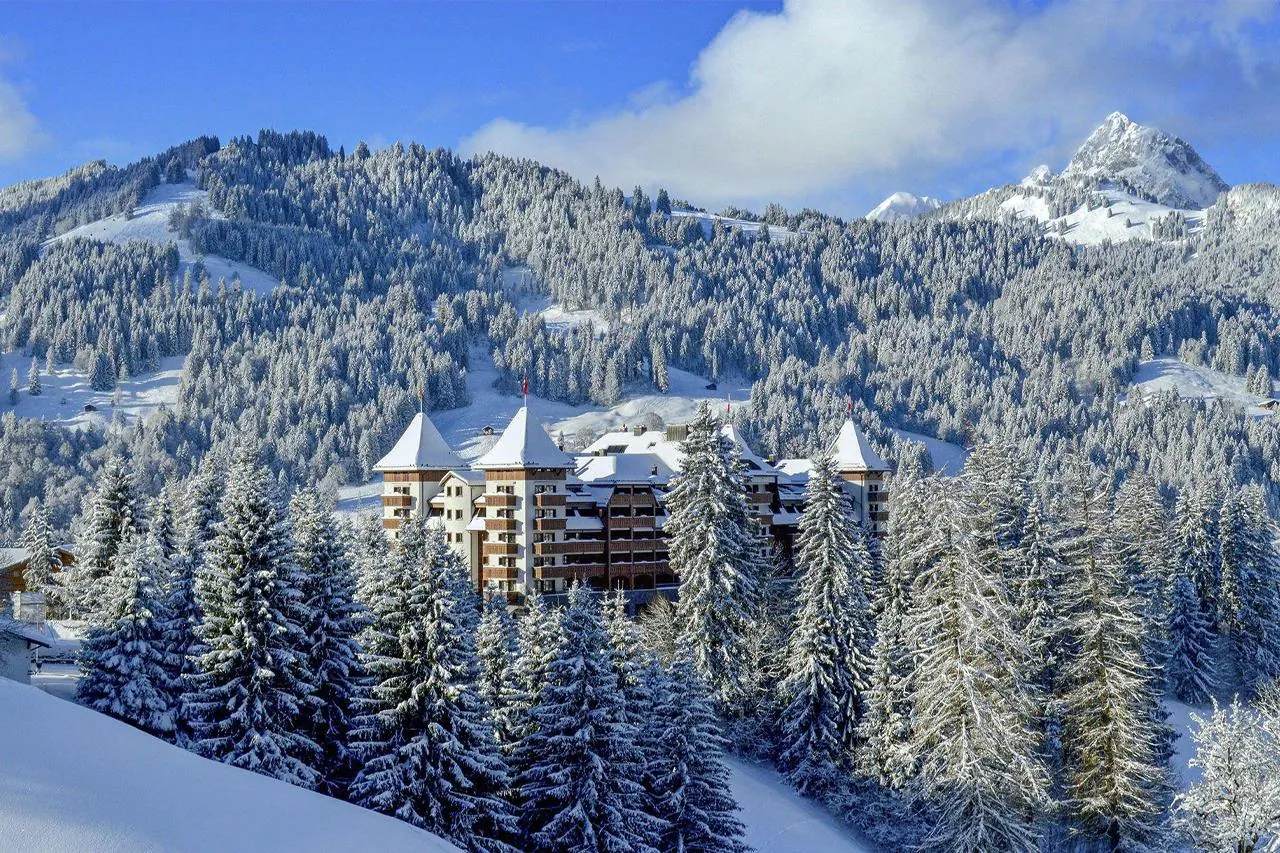
Gstaad lies 155 kilometres from Geneva Airport, on the far side of the Pre-Alps, and nothing leads there in a straight line, neither a motorway nor a direct train. You either go round the range to the north, through Gruyère, or cross it by a pass from the Rhône valley. Far from being a flaw, the detour is part of the trip, whether by rail or by road. This guide describes the possible routes, what each demands in time and organisation, and the situations in which one of them is the obvious choice.
- Distance by road About 155 km
- By car Around 2 h 15 via Bulle and the Pays-d'Enhaut
- By train About 3 hours, with one change at Montreux
- Final part Some forty kilometres of valley road, limited to 80 and then 50 km/h
- Possible passes Les Mosses (1,445 m) and Le Pillon (1,546 m), open all year barring bad weather
- Arrival station Gstaad, in the centre of the village
The train: an hour of lake, then the panoramic line
From the airport station, direct trains get to Montreux in a little over an hour. There you change to the narrow-gauge MOB line, which leaves from the same station. The train zigzags up above Lake Geneva, passes beneath the Col de Jaman in a tunnel and runs down to Montbovon, then follows the valley up through Château-d'Œx, Rougemont and Saanen. It needs about an hour and twenty-five minutes to reach Gstaad.
Several kinds of rolling stock operate on this line: panoramic coaches with huge windows, Belle Époque-style carriages and, since the end of 2022, the GoldenPass Express, which continues to Interlaken without a change. Some of them require a seat reservation; ordinary regional trains do not.
Gstaad station is a stone's throw from the pedestrian Promenade. For a hotel in the centre, the train therefore sets you down almost at the door, and many establishments also collect their guests from the platform. It is the most enjoyable way to travel when you have time and little luggage. With skis and several suitcases, the change at Montreux and the overall duration of close to three hours weigh more heavily.
Driving yourself: three approaches, only one without a pass
The simplest road follows the motorway to Bulle, by way of Lausanne and Vevey, then the Sarine valley and the Pays-d'Enhaut to Saanen. It crosses no pass and is suitable in any season. Its final part runs through a string of villages, and there is no point hoping to overtake.
The other two approaches start from Aigle in the Rhône valley. One climbs to the Col des Mosses and comes down to Château-d'Œx; the other goes through Les Diablerets and over the Col du Pillon, then descends to Gsteig. The distances are similar and the roads more winding. In summer they offer splendid scenery. In winter they normally stay open but become snow-covered sooner than the Bulle road: winter tyres are essential, with chains in the boot as a precaution.
If you hire a car, collect it in the Swiss sector of the airport. It will then carry the vignette required on motorways, and Swiss rental firms equip their vehicles for winter as a rule. Once there, a car is easier to justify than elsewhere, because the villages of the Saanenland and the various ski mountains lie some way apart, even though local buses and trains connect them.
Being driven
A chauffeur-driven car booked in advance leaves the airport as soon as you have your luggage and sets you down at your chalet or hotel in about two and a quarter hours. The driver chooses between the three roads according to the day's traffic and weather. The amount is fixed when you order. For a family, a group or a traveller expected at a set time, it is the shortest and least tiring option; for one person in no hurry, the train costs less.
Shared shuttles, common towards the big French and Valais resorts, are rare on this corridor. Do not rely on them without checking that a service exists on your dates. There is no scheduled coach either.
Arriving through another airport
Gstaad has its own airfield, at Saanen, used by private aircraft and helicopters. For commercial flights, Geneva is the nearest international airport by road. Zurich is appreciably further, close to three hours by car or by train via Bern and Spiez. The small airport at Bern, about an hour and a half away, has only a few scheduled services.
If your trip strings together several stops in Switzerland, the order matters: by flying into Geneva and out of Zurich, or the reverse, you avoid covering the same ground twice.
Seasons, days and hours: when to travel
Gstaad lives on two high seasons. From Christmas to mid-March, Saturdays are the busiest days, above all around New Year and in February. In July and August the tournaments and the music festival fill the region; traffic stays fluid, but accommodation and pre-booked transport become scarce. Between those periods, in April, May and November, many hotels and lifts close: the journey is easy and the village very quiet.
On the motorway section, the usual slow-downs occur around Lausanne at office hours and between Lausanne and Vevey late on Fridays. By train, the final connections from Montreux to Gstaad leave during the evening, so after a late landing check the timetable before committing yourself.
To catch your flight home, work backwards. By car, leave four and a half hours before take-off. By train, choose an arrival at the airport at least two hours before the flight and keep one connection in reserve at Montreux.
Frequently asked questions
Frequently asked questions
Is there a direct train from Geneva Airport to Gstaad?
No. You have to change once, at Montreux, to take the MOB mountain line.
How long does the journey take?
About 2 h 15 by car and 3 hours by train, including the connection.
Do you have to cross a pass to get to Gstaad?
Not on the Bulle road, which stays on the valley floor. The Mosses and Pillon passes are alternatives starting from Aigle.
Is the road usable in winter?
Yes. All three approaches are maintained throughout the winter; only severe snowstorms occasionally cause a pass to be closed for a short time. Winter equipment remains essential.
Do I have to reserve a seat on the panoramic train?
For certain trains and classes, yes. The regional trains that run on the same line can be used without a reservation on an ordinary ticket.
Do I need a car in Gstaad?
Not in the village, which is easily covered on foot. It is handy for getting from one village or ski mountain to another; ask too about the guest card, which makes local buses and trains easier to use.
Can I visit Gruyères on the way?
Yes, on the Bulle road: the medieval town is a few minutes off the route. By train it would mean a detour via Montbovon and an extra change.
More guides
-
Geneva Airport to Aix-en-Provence: How to Get There
An out-of-town TGV station, two road itineraries, door-to-door times: the journey from Geneva to Aix-en-Provence explained.
Read the guide
-
Geneva Airport to Aix-les-Bains: The Journey Guide
Direct train from Cornavin, the A41 or a chauffeur: the trip from Geneva Airport to Aix-les-Bains, with useful advice for spa visitors.
Read the guide
-
Geneva Airport to Alpe d'Huez: Travel Time, Route and Transport Options
215 km via Grenoble, a little over three hours: a guide to travelling from Geneva Airport to Alpe d'Huez, and to deciding whether Geneva is the right choice.
Read the guide
Ready to book your chauffeur?
Get your price online in a few seconds, or contact us on WhatsApp — we answer 24/7.