
Practical guide
How to Plan a VIP Visit to Geneva: The Assistant's Checklist
What personal assistants check before sending their principal to Geneva, point by point.
How to plan a VIP visit to Geneva: an easy city, give or take a few details
To plan a VIP visit to Geneva is not especially difficult: the city is safe, compact and used to demanding visitors. It does have its customs, though, and they surprise people arriving from London, Dubai or New York. Shops close early, Sunday really is Sunday, and the weeks of major events are booked months ahead. This list sets out, in the order of the trip, what is worth having checked. It is aimed at personal assistants, household managers and travel coordinators preparing a first stay.
- Currency Swiss franc; euros are often accepted, with change given in francs
- Language French; English is widely spoken in hotels and shops
- Sunday Shops closed, apart from those at the station and the airport
- Tipping Service is included in prices; rounding up remains a welcome gesture
- Power sockets Type J, with three pins; bring an adaptor
- Emergencies 144 for an ambulance, 117 for the police, 118 for the fire brigade, 112 from a mobile
1. Check the calendar before fixing the dates
Geneva has few rooms for the number of international gatherings it hosts. During the spring watch fair, the World Health Assembly in May or the International Labour Conference in June, suites become scarce and so do restaurant tables. The auctions in May and November fill the palace hotels on the lakefront. If the dates are open, avoid those weeks; if they are imposed, book everything at once: room, car, restaurants.
2. Choose how to arrive
On a scheduled flight, the passenger goes through the main terminal like everyone else. The airport and specialist providers offer paid reception services, with an escort from the aircraft door; ask them directly what is possible for your flight.
On a private flight, arrival is at the business aviation terminal, a separate building where formalities take only a few minutes.
By train, from Paris or Milan, you arrive at Cornavin station, right in the centre. It is sometimes the most discreet solution of all.
3. Place the hotel in relation to the programme
The lake separates two Genevas. The right bank holds the palace hotels on the quays, the station, the international organisations and quick access to the airport. The left bank holds the boutiques, the Old Town, the banks and the residential districts. A programme centred on the Nations district from a left-bank hotel means two crossings a day at rush hour. Hotels set in parkland, towards Bellevue or on the Cologny hillside, offer calm at the cost of fifteen to twenty minutes' drive to the centre.
4. Plan how to get around
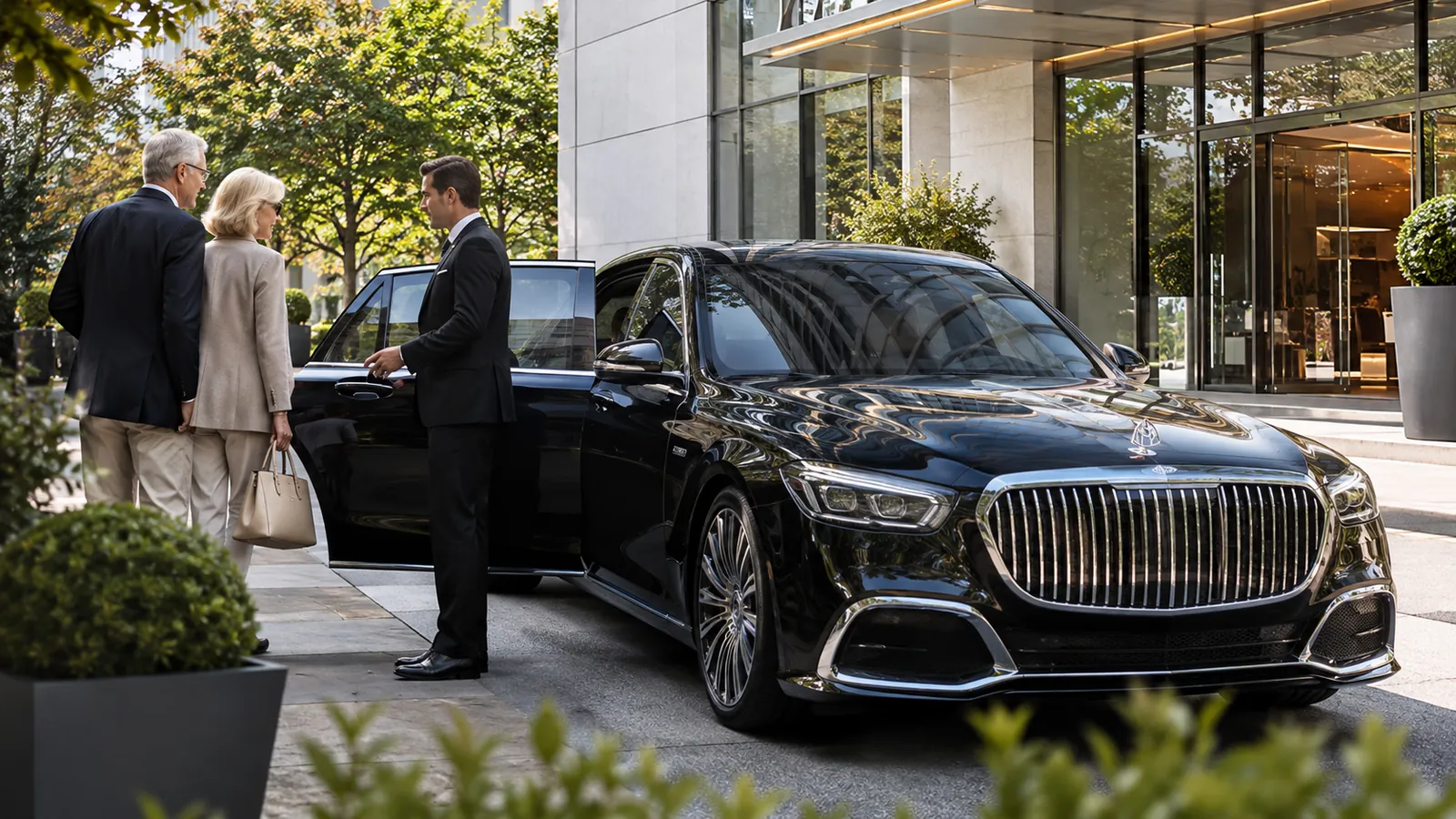
A chauffeur-driven car, booked by the hour or by the journey, remains the solution for full programmes and for passengers who value discretion. The vehicle, the timing and the price are settled in advance.
The hotel car. Several palace hotels have house vehicles for short trips. Check the conditions and availability, which are not guaranteed in busy periods.
A taxi helps out for an unplanned trip; the concierge will call one within minutes.
Walking is often the best way between Rue du Rhône, the Old Town and the quays: everything fits within a kilometre. The Mouettes, the small yellow boats of the public network, cross the harbour in a few minutes and delight children.
To leave the city, allow about 1 hour 15 to Montreux, 1 hour 20 to Megève and a little over two hours to Verbier or Gstaad, starting from the airport.
5. Know the local opening hours
This is the point that causes most surprise. Shops close in the early evening on weekdays and in the late afternoon on Saturdays, and stay closed on Sundays. A shopping session therefore belongs in the daytime, never after dinner. The major houses on Rue du Rhône receive clients by appointment; a call the day before secures a private room and a sales adviser who speaks the right language.
Restaurants serve early: lunch starts at noon, dinner at 7 pm, and many kitchens close at around 10 pm. A good number of restaurants are closed on Sundays or Mondays. For a late dinner, hotel restaurants are the most accommodating.
6. Think ahead about the border and tax refunds
France begins a few minutes from the centre, and many excursions cross into it: Annecy, Chamonix, Évian, Megève. Every traveller should therefore carry a passport, with a visa where one is required. Switzerland belongs to the Schengen area but not to the European customs union: sizeable purchases may be checked at the crossing.
Visitors who do not live in Switzerland can claim back the VAT on their purchases. The shop issues a form, which customs stamp on leaving the country; allow a few extra minutes at the airport and keep the items accessible.
7. Settle the question of security
Geneva is a quiet city, and most visitors move around without protection. When a security team accompanies the traveller, one point must be checked before departure: private security work requires authorisation in the canton. A team coming from abroad would do well to enquire with the Geneva authorities or to rely on a licensed local firm.
Beyond that, ordinary caution is enough: do not circulate the name of the hotel, limit the number of people who know the programme, and agree on a single channel for changes.
8. Put everything on one page
The document handed to the traveller and to those around them fits on one sheet: flight times and numbers or the aircraft's registration, the chauffeur's name and telephone number, the hotel's address and contact, confirmed reservations with their times, emergency numbers, and the name of the one person to call if something unexpected happens. Anything not on it will be asked for by telephone at the worst possible moment.
Frequently asked questions
Frequently asked questions
What is the best time of year for a stay in Geneva?
May to September for the lake and the terraces, December to March if the stay continues in a ski resort. Avoid the weeks of major fairs and conferences if you are looking for calm.
Are the shops open on Sundays?
No, with the exception of those at the station and the airport. Plan shopping from Monday to Saturday.
Should you leave a tip?
Service is included in prices in Switzerland. People readily round up the bill when they have been well served, but it is not expected.
Can you pay in euros?
Often, in hotels and large shops, but the rate applied is seldom favourable and change is given in francs. Cards are accepted almost everywhere.
Is a passport needed for an excursion to Annecy or Chamonix?
Yes, a valid identity document is needed to enter France and return to Switzerland, even though checks are not systematic.
How do you get around the centre?
On foot for short distances, and by chauffeur-driven car as soon as the programme involves several stops, luggage or a tight schedule.
More guides
-
Geneva Airport to Aix-en-Provence: How to Get There
An out-of-town TGV station, two road itineraries, door-to-door times: the journey from Geneva to Aix-en-Provence explained.
Read the guide
-
Geneva Airport to Aix-les-Bains: The Journey Guide
Direct train from Cornavin, the A41 or a chauffeur: the trip from Geneva Airport to Aix-les-Bains, with useful advice for spa visitors.
Read the guide
-
Geneva Airport to Alpe d'Huez: Travel Time, Route and Transport Options
215 km via Grenoble, a little over three hours: a guide to travelling from Geneva Airport to Alpe d'Huez, and to deciding whether Geneva is the right choice.
Read the guide
Ready to book your chauffeur?
Get your price online in a few seconds, or contact us on WhatsApp — we answer 24/7.